Home Blog

A Boating License, a Long-Held Dream, and Palermo from the Sea

0
Giovanni Morreale at the helm of a motorboat off the coast of Palermo
At the helm, off the coast of Palermo.

About ten years ago, a group of parents from my son’s International School began exploring the idea of getting a boating license, and I joined them to find out more. Several of them went on to take the course and earn their licenses. I felt the pull of that adventure too, but I was living mostly in England, traveling back and forth to Sicily. Much as I wanted to join them, my own plans would have to wait.

The school they chose was Il Sestante in Palermo, run by Claudio. I joined an introductory boat trip back then and enjoyed it. This year, with the summer ahead, I finally enrolled in the course.

The course was taught by Salvatore, whom I found truly inspiring. As the lessons went on, I kept noticing parallels between steering a boat and steering a life.

Salvatore’s lessons brought old memories back. I grew up in a small village on the coast of Sicily. As a boy, I would sometimes go fishing with my father and my uncle in a small boat, never far from the shore. We laid our net at dusk and came back for it at first light. One day the calm sea turned in less than an hour, and our little engine struggled against it. When Salvatore warned us how quickly things can become difficult at sea, I already knew.

We learned to read a nautical chart, plot a route, work out distances and fuel. But what I loved most was the compass rose and the names of the winds. Tramontana comes from beyond the mountains, Grecale from Greece, Scirocco from the deserts to the southeast, Libeccio from Libya. Each name is a direction and a piece of geography at once. And the whole Mediterranean shares them: in Catalonia, where I live now, they are Tramuntana, Gregal, Xaloc. Around this sea, the wind has always carried the name of the land it comes from.

Nautical chart with dividers and a plotter during the boating license course
Learning to read a nautical chart.

Those winds are more than names on a compass rose. The wind pushes the boat, and it moves the water too, shaping the currents beneath you. You set a course, and both quietly pull you away from it. You have to understand what is happening, adjust, sometimes find shelter, sometimes use those same forces to your advantage. I kept thinking about life. You can have a clear direction in your head, but you still have to deal with what comes from outside, and keep adjusting.

Even the driest subject, the rules for avoiding collisions, came alive once I was aboard. Now I look at lights on boats and around the harbor and try to read what they are telling me. It feels like beginning another language. You learn a few words and realize how much you still cannot read.

My grandmother, who knew I was always in a boat or diving, had her own warning: “A cura ca ‘nno mari non ci su troffe.” Be careful: at sea there are no bushes to grab if you fall.

Exam room at the Capitaneria di Porto in Palermo, with signal flags on the wall
The exam room at the Capitaneria di Porto.

Then came the practical exam in Palermo’s port. The examiner from the Capitaneria was very formal. We did maneuvers, a man-overboard exercise and an alongside docking maneuver, known in Italian as ormeggio all’inglese. The wind was pushing us sideways, and my first attempt did not go well.

I was afraid I might fail. I asked whether I should try again.

“What do you think?” he replied.

Claudio and Alex were aboard. Alex had organized our lessons and, at the end of the summer, taken us out for the practical sessions before the exam. Now they were both trying to guide me with their eyes. I made another attempt and managed it. The examiner remained formal right to the end; when he stepped off, he did not even say goodbye. I had no idea whether I had passed.

During the exam, he had also asked me why Claudio’s boat was flying the Italian flag. I could not answer.

I know now. But I am leaving that one for you: guess in the comments, or come and find out for yourself with a lesson at Il Sestante.

One Sunday, I met Claudio and Alex at the little harbor of Acquasanta for an aperitivo. To my surprise, they handed me my license. All the tension of the exam was gone in a moment, and I had not felt so excited in years.

But a license is only the beginning, and I wanted more experience. So I asked Claudio to take the boat out again. This time there was no examiner aboard: just a couple of hours at sea, in a relaxed and friendly spirit, with time to learn. Before we set off, we spent about half an hour going around the boat: the bilge pump, the extinguishers, the life jackets, the batteries, what each powered, what to switch off and what to leave on. Things I had studied became things I could point to and understand.

I thought about life once more. Having the courage to leave is one thing; knowing something about what you are stepping into matters too. These are the checks I want to make every time I take a boat out.

And then there was Palermo.

We left from near the Florio tonnara and followed the coast toward Villa Igiea. I practiced maneuvering between the moored boats below the villa: the little harbor, the cave you see in my photographs and the whole coastline turned the lesson into a pleasure. On the way back, the tonnara seen from the sea looked more beautiful than my photographs can show.

A small harbor and cave below Villa Igiea, Acquasanta, Palermo
The little harbor and the cave below Villa Igiea.
The tower of the Florio tonnara at Arenella, with Monte Pellegrino behind
The Florio tonnara, seen from the sea.

Passing the Quattro Pizzi, I called my friend Chico, and a quick hello became an unplanned stop with him and his wife, Ana Paula, two of the people I hope you will meet through these stories. Chico had just come back from a regatta, and his advice was simple: I had learned the ABC. The real lessons would come from time at sea, from practice and from learning to handle difficulties. That was exactly how I felt. (There is also a curious yellow object at the Quattro Pizzi, with a story that deserves an article of its own.)

A yellow submersible-like object at the Quattro Pizzi, Arenella
The curious yellow object at the Quattro Pizzi. A story for another day.

What comes next? My license is for motorboats within 12 nautical miles of the coast. Claudio encourages me toward a motorboat; Chico speaks of sailing, and of the wind that does not always arrive when you want it. Sailing still feels to me like navigation in its original form, but for this first year I want plenty of practice under power: berthing, reversing, understanding how a boat responds. Those skills will matter on any boat.

It fits this moment in my life. I am still moving between Barcelona and Palermo, following the wind a little, using the engines a little, working out where I want to go. I have a license now. I still have a great deal to learn.

Good to know

As of November 2026.

  • The school: Il Sestante, Palermo, with Claudio. Salvatore taught my course; Alex organized the lessons and the practice at sea. You can find the school on Facebook.
  • The place: the Quattro Pizzi at the Florio tonnara in Arenella. Casa Florio has information about it.
  • Training and trips at sea: Claudio and his team organize training sessions at sea along this coast. Ask them through the same Facebook page.
  • Questions about boating licenses in Italy? Write to us and we will point you in the right direction.

I hope you will follow this new chapter of my life here at Times of Sicily. Join our community, come and see us in Palermo, and perhaps we will find ourselves out on the water together. I will keep practicing whenever the weather allows, and sharing what I learn. There is still that question about the flag.

More from the course and the sea

Virgil, Sicily, and the Founding of Rome

0

In the course of the last two years, we have spent a lot of time investigating literary connections to Italy’s capital for our new book, The Book Lover’s Guide to Rome.  We decided to write in chronological order, starting with the Classical period, by taking a look at Virgil’s Aeneid, specifically with reference to Aeneas and Evander as they walk the latter’s domains – a conceit that allows Virgil to wax lyrical about the Rome to come.  However, even with a cursory perusal of Virgil’s magnum opus, the curious reader will spot many references to the Sicily experienced by Aeneas, the legendary ancestor of Romulus and Remus.  His Trinacria is a key destination in linking the Trojan/Greek past to his Roman future.  In fact, the island features in more than one of the books that make up the entire volume.

So how did Virgil’s hero find himself in Trinacria and what did he do there?  In Book 3 of The Aeneid, Aeneas recounts his story to Queen Dido in Carthage.  After a brush with Charybdis in the Straits of Messina and the Cyclops at Aci Trezza, he tells Dido that his Trojan fleet made for Ortygia, the island just off the Syracusan mainland on the eastern coast of Sicily.  As a spot ruled by Anius, a friend of his father Anchises, and righteously blessed by the god Apollo, Aeneas is sure he will be able to seek the god’s guidance.  As he is to find out, the site is in fact redolent of all the old gods – in glowing terms, Virgil portrays the Arethusa Fountain: ‘Alpheus, as old fame reports, has found from Greece a secret passage underground, by love to beauteous Arethusa led’. Subsequently departing Ortygia, Aeneas then rounds Cape Pachynus, passing Gela before spotting Akragas ‘with lofty summits crown’d’.  Akragas and its lofty summits, of course, refer to Agrigento and its Valle dei Templi.

The Arethusa Fountain, Ortigia, Siracusa

Next on his tour of what we would now consider the delights of Sicilian antiquity is Selinus and the ‘palmy land’.  Selinus aka Selinunte, the archeological park to the southeast of Mazara del Vallo, draws thousands to its acres of temple ruins.  Wisely, Aeneas then decides to ‘shun the Lilybaean strand, unsafe, for secret rocks and moving sand’.  Lilybaeum was the Latin name for the modern town of Marsala and anyone who has wandered around this part of Sicily will know it is right next to the salt flats and an area of very flat land extending out into shallow waters. Book 3 ends with the disheartening news that Anchises, our hero’s father, has died from old age at his home in nearby Drepanum (Trapani).

Ruins at Selinunte

After an interval in Book 4, during which time we learn of Queen Dido’s love for Aeneas and her tragic suicide, we return to Sicily in Book 5.  Aeneas and his fleet are in Drepanum.  He then decides to pay homage at Anchises’ tomb where, as Virgil tell us, he ‘pour’d to Bacchus, on the hallow’d ground, two bowls of sparkling wine…’  His father’s ghost arises to lament the fact that they never reached Rome together or the ‘Tiber’s flood’.  Funeral games are organised in Anchises’ honour, a tradition that was common to more than one society from the Classical period.  

As part of the memorial activities, Acestes, the King of Segesta, welcomes Aeneas warmly.  The son of Egesta of Troy and the river god, Crimisus, Acestes, as critics have noted, serves to emphasize the mythical link between Sicily and Troy.  Amidst the games, with heroes rewarded for their endeavours, Segesta’s spectacularly located theatre appears to be referenced in the text.  (N.B. it’s actually a 3rd century BCE construction): ‘Into the neighb’ring plain, with mountains pent, whose sides were shaded with surrounding woods.  Full in the midst of this fair valley stood a native theatre, which, rising slow by just degrees, o’erlook’d the ground below.’  As myth is wont to bend reality, Virgil’s geo-chronological references should not be taken as gospel.

The theatre at Segesta

As the games continue, it seems the Trojan women are unhappy.  The goddess, Juno, disguised as an old crone, realises that the women are exhausted from their seven-year search for a home.  Seizing the opportunity to make a little mischief, she sows the seeds of discontent and eventually torches the ships in Drepanum harbour.  Aeneas, on learning of the disaster, throws himself on the mercy of Jupiter who sends a torrential storm to quell the flames.  Yet, even our hero is conflicted: ‘But doubtful thoughts the hero’s heart divide; if he should still in Sicily reside.’ 

Anchises makes yet another otherworldly appearance to his son, making the stark suggestion that he should take a little trip to the underworld in order to receive a vision of things to come, promising him it would reveal his own and, indeed, Rome’s future.  The dilemma over who goes and who stays is solved by splitting the Trojans between crew and settlers.  Those charged with staying lay down the outlines of a temple to Venus and the boundaries of their settlement.  Mount Eryx (now Erice), today reachable from Trapani by cable car, used to boast the Temple of Venus Erycina.  It was replaced by a Norman castle in the 12th century.  

After sacrificing an unfortunate crew member to the gods due to the inauspicious attentions of Somnus, the personification of sleep, the Trojans assigned to the crew sail to the underworld via the oracular attentions of the Cumaean Sibyl, and then on to Latium, their ultimate destiny.  With a firm Sicilian glint in our eye, and a knowing wink to the past, we wonder if Aeneas or, for that matter, Rome, would have been the same if it weren’t for this Trojan sojourn on the island of Trinacria.  The founding myth of Rome owes more than a few sesterces to the island it has so often used as a political football.  

All quotes from The Aeneid come from John Dryden’s verse translation.

Among other works, Andrew and Suzanne Edwards are the authors of the recently published The Book Lover’s Guide to Rome and a previous work on literary journeys, Sicily: A Literary Guide for Travellers.

ITALIAN AMERICAN BOY BATTERED BY BIGOTRY

1

My Sicilian mamma Crucifessa worked at home selling homes to Italians. She also embroidered and sewed to earn extra cash. My Papa was totally busy outside our home captaining boats, and in later life, working in factories.

I remember seeing him slump after his long hours city work. In fact, my friends on our make-shift ball field provided an early warning system, alerting me of my Papa’s walking home from the subway station..

They yelled, “Your dad is on his way. Run home!” I shook, anticipating a spanking for lateness to the dinner table. In retrospect, my alarm was unfounded. I was never hit for being late .It was a fake charade by my father, I’m gonna take my belt off now.”

Amazing that well coordinated Sicilian always seemed to miss me with his belt at point blank range. Momma of course, pretended to provide a buffer.

Regularly, when Pop entered our home after city work he dropped tiny chocolates bought from subway vending machines directly on the floor next to me. That floor blanketed with baseball cards shared space with mini chocolate ,and the Journal American newspaper’s sport page. Jimmy Cannon, famed sports writer proved my favorite author and the reason my teaching nuns seemed amazed at my esoteric vocabulary.

Mamma taught me lifetime lessons in confronting bigotry. She handled that social disease with dignity, pride, patience, constructive reaction.  She was rewarded with the proverbial last laugh. Fifth grade was the springtime of my life, I rode a city bus frequently with mom.    One day she asked the bus driver a question in her so-called broken English. A sneering driver mocked and mimicked her. A bus filled with other riders brandishing Germanic accents giggled and laughed and even shouted at her. She wore the insulting cloak of a scapegoat suffering from the original sin of being Italian.

At ten, I felt trapped in a noisy bus, a  green gassy bus literally like a rolling cage with toothy human animals viciously laughing at my mom. Enraged and in pain, I recall that infamy.

On the way out of the bus I kicked the driver. He screamed, “You slimy, wop guinea bastard.” He got up, took one step then sat immediately and slammed the doors.

Momma said, “Antouzzu why did you kick that man?”

I said,” I don’t know what those words mean, but I know that they are mean.” That was the first time that I realized that others referred to us as Wops and Guinea bastards.

I asked my Mamma the meanings of the insults. “I will explain some other time, “she said.

I’ve never hated more or wanted to strike back harder. For years the thought of avenging that moment haunted me. At that time, however, mom silenced and put her finger over her mouth to prevent any negative reaction from me.

Instead, on that steamy Brooklyn afternoon she clutched my hand, gave me a gentle extra squeeze a delicate whisper of love and said in Italian, “Relax, they won’t win. “I noticed that she copied some writing printed on that bus.it was probably related to the bus and its driver. Surely, she avenged that insult.

A year later, my parents considered renting in an apartment building closer to my parochial school. Mamma walked with me into an enormous, flower filled courtyard. As we approached its entrance, men and women hanging out of their windows gestured and yelled at us. In Germanic accents it seemed like a chorus of folks from every corner shouted, “Get out, we don’t want Guinea Wops here!” My mom bit down on her lip and was determined to enter to speak to some rental agent. She was stopped at the door by a large pot bellied. and horned rimmed man. He put his crusty hands across mom’s face and said,” We don’t have and vacancies?” We turned and she took small backup steps. I asked, “What are vacancies?”

She said, “My son the man means that they don’t have any open apartments. She stared at the pavement momentarily. That alerted me of her disappointment.

“Mom I heard those bad words about us again.” She rubbed my head, “My boy you will realize that intelligently standing up to that kind of ignorance and evil will make you a better man. Don’t allow them to imprint negativity on your soul.”

Those two early warnings about the bigotry that confronted this American born Italian American in the Fifties were a lesson. Nowadays, whenever I detect any kind of bigotry against others, I ask, What would Mamma do?

Spanish Echoes in Sicilian Speech

0

There are journeys we make with our feet — and others we make with our tongue.

This one began, oddly enough, in a Spanish class in Barcelona, where I, a wandering Sicilian trying to tame verbs and accents, kept coming across  familiar sounds. Words that felt like cousins who had emigrated years ago and suddenly knocked on my classroom door.

Oftentimes, when Vania — a warm, smiling teacher — introduced a new Spanish word, a small breeze rose in the back of my mind, like an old friend whispering: “But wait… we say this too in Sicilian” One day, my classmate Chiabi, a bright Hungarian with the curiosity of a linguist, turned to me and asked: “Is Sicilian actually a language?”

Ah, the temptation. I nearly unleashed a full disquisizione — footnotes, historical detours, maybe even a cameo from the Opera dei Pupi. But I behaved. I simply told him: Yes. Sicilian is a language. A complete one. With its own grammar, syntax, and dictionaries.

And in that moment, I remembered the treasure I keep at home with almost devotional care: my five-volume Vocabolario Siciliano, over six thousand pages — five monumental tomes that weigh as much as a small donkey and contain centuries of stories, migrations, kings, farmers, sailors, and winds from every corner of the island.

For a second, I imagined pulling all five out of my backpack — abracadabra! — and placing them gently on the classroom table. But then I remembered Peter — a very likable classmate from Sheffield, blessed with classic English humour — gets suspicious around anyone displaying signs of intelligence above room temperature. So, I toned it down and did the next best thing… I opened my laptop and began searching for a digital Sicilian vocabulary to show him.

So I began my online pilgrimage: a little Google here, a little academic database there. And then — unexpectedly — I fell into a rabbit hole. One click led to another, and suddenly, as if some librarian-angel in another timezone whispered “try this one”, I landed on a scanned 19th-century Sicilian vocabulary preserved by the University of Illinois. Yes, Illinois.

A treasure printed before Garibaldi was even warming up his horse. The dictionary belonged to Conte Antonio Cavagna Sangiuliani di Gualdana, a Lombard aristocrat with no Sicilian origins — yet his private library of 50,000 books included rare Sicilian glossaries. From Sicily to Lombardy to Illinois… and now to my kitchen table in Barcelona.

My curiosity started with one of my favourite words: gana — appetite, desire — a word I knew had a Spanish heartbeat. And there it was: gana, quietly waiting on a page that had travelled farther than I ever had. Some words have more frequent-flyer miles than we do. And you think, language is not a list of words. It is a journey. And sometimes that journey takes you from Palermo to Barcelona… and unexpectedly through Illinois.

But a language is also History.  History doesn’t always shout; sometimes it murmurs through syllables. As you know, Sicily is a mosaic of tongues: Greek, Latin, Arabic, French, Catalan, Spanish. Each left a sediment, a trace, a whisper. Let me share a few “Spanishified” ones.

Sicily first fell under Aragonese rule in 1282, after the famous Vespri Siciliani, the revolt that expelled the French from the island. From that moment, the island entered a long Iberian orbit: first under the Crown of Aragon (1282–1516), then under the unified Spanish monarchy of the Habsburgs (1516–1713), and finally under the Bourbon dynasty of Spain (1735–1860).

With only a brief interruption by the Savoy (1713–1720) and the Austrians (1720–1735), the Iberian presence in Sicily lasted, remarkably, almost six centuries. During that vast stretch of time, countless soldiers, merchants, priests, sailors, clerks, and administrators crossed the sea.

They didn’t leave behind grand cathedrals or imperial arches; they left something more subtle and more stubborn: words. Vocabulary, idioms, and grammar patterns slipped quietly into the Sicilian language and settled there, surviving long after the coats of arms were pulled down and the flags changed colour.

What remains today is a kind of linguistic sediment: Spanish roots growing in Sicilian soil. And now, studying Spanish in Barcelona, I feel this curious sensation — as if the language I’m learning is not entirely foreign, but rather a distant cousin of the one I grew up speaking.

And yes, I did grow up with it. I won’t even try to list every similarity, but a few of them deserve to be mentioned — especially for the memories they carry. Some of these words are completely different from Italian, yet when I hear them in Spanish, they sound like home. They sound like my mother, my grandmother, speaking to me in the warm streets and sun of Sicily.

If I had to begin somewhere, I’d start with rina.In Spanish it becomes arena, in Italian sabbia — but for me, rina is much more than just “sand.” It is the heart of my childhood. The essence of who I am. Growing up in a small village on the Sicilian coast, rina was what warmed our bare feet, what we touched before diving into the sea, what marked entire days of summer spent on the beach.

Lastima! There is no equivalent in Italian! That’s my grandmother Joachina  and granfather Toto’. This word carries the weight of old sighs. My mother less so; I barely say it anymore — a gentle erosion across three generations. But hearing lástima appear so casually in my Spanish class made something inside me wake up. I told myself: I should start using làstima again. Some words deserve resurrection — especially the ones that once carried our family’s tenderness and melancholy. And in the Illinois vocabulary, làstima was right there, waiting like an old postcard.

Limpiar – This memory surfaced when I was trying to find the Spanish term for “cleaning lady” — mujer de la limpieza — and suddenly realised how close it sounded to the Sicilian limpiari. Same meaning, same melody. No trace of this in Italian, which instead uses pulire.

And hearing limpiar brought me straight back to my aunt in Montedoro, that little hilltown in the heart of Sicily where my father was born. Not because she was a cleaning lady — but because the word carries with it the atmosphere of that place: houses with their doors thrown wide open, freshly washed floors glistening under the midday sun, waiting only a few minutes before the warm Sicilian summer wind swept through and dried everything as if by magic. Madonna santa, I can still smell it — that mix of soap, stone, sunshine, and home.

And then there is rasca. When Vania — mi profesora buenísima — was guiding us through the vocabulary of the barrio, she casually mentioned the word rascacielos. I hesitated. In Sicilian, rasca means “to scratch.” So a rascacielo is literally a sky-scratcher — a skyscraper with nails. The same verb that lives in Sicilian had simply climbed a few more floors.

And then there is zita — one of the most romantic echoes of all. In Spanish, cita means a date — the moment two people decide to meet. From this meaning, the Sicilian word zita was born. But here is the beautiful twist: in Spanish, cita can also mean an appointment — with a doctor, a lawyer, a government office. A perfectly ordinary, everyday slot in the calendar. In Sicilian, zita lost all those practical uses. It kept only the “romantic” heart of the word. Zita is never an appointment. It’s your date.

Maybe my last discovery came thanks to my cousin Salvatore, who also lives in Madrid. I wrote to him: “To, send me a few Spanish words that sound Sicilian to you.” The first one he sent was strafalario. I burst out laughing. “Is that really Spanish?” I asked. “Claro,” he replied. In fact, it comes straight from the Spanish estrafalario — eccentric, odd, delightfully bizarre in appearance or behaviour. And the funny thing is: we Sicilians still use strafalario in exactly the same way today. Another little linguistic migrant, alive and well on both sides of the sea.

I could fill pages with these mini-stories — little words that have travelled farther than I ever have, each with its own anecdote, each carrying a secret passport: cucchiara – cuchara (spoon); arbolu – árbol (tree); palumma – paloma (dove); abocar – abbuccari (to pour); smammare – desmamar (which can mean get lost, go crazy, or freak out). But perhaps it’s better to save the rest for a glass of red wine, in some cosy bar in Barcelona, while I go on learning this idioma and its culture, one delightful echo at a time.

Soon I’ll share another journey — a glance at some of the grammar we share, where Sicilian and Spanish mirror each other with almost mischievous precision. Stay tuned.

Studying Spanish in Barcelona brought me back to Sicily — and Sicily quietly pointed me towards a library in Illinois. Three places with one memory thread. Words don’t die; they simply slumber. And when we speak them again, we bring them home.

Nuovo Cinema Paradiso & the Train That Keeps Leaving

1

“Don’t come back. Don’t let nostalgia fool you. Forget us all.”

— Alfredo to Totò, Cinema Paradiso

It all began here. Watching a post about Cinema Paradiso, that farewell scene at the station — Alfredo sending Totò off into the world — I felt that those words were speaking to me too.

And now, to my son.

They awaken memories that move in circles, as if every generation were destined to live its own version of leaving, of distance, of the return that never quite happens. But today, after so many years and so many departures, I realize that maybe that line needs to be rewritten.

Don’t come back, maybe. Because leaving no longer means forgetting.

Today, those who leave can remain tied to their homeland in new, invisible, digital, and deeply human ways.

Nuovo Cinema Paradiso is more than a film — it’s a fragment of who we are. The story of a little boy who fell in love with cinema — cutting and splicing reels in a small Sicilian village — and of the man he became, forever chasing the light of that lost screen.

The masterpiece by Giuseppe Tornatore, a director from Bagheria, won the Academy Award for Best Foreign Film in 1990, bringing Sicily back to the world’s grandest stage.

It was not only a cinematic triumph but a human one. Through the story of Totò and his mentor Alfredo, Tornatore revealed the Sicily of memory and longing, of imperfect beauty and unbreakable affection — the Sicily that lives in the hearts of those who left and in the dreams of those who stayed.

For many Sicilians scattered across the world, the film became a window back home, a reason for pride and belonging. It was as if it was whispering: Here we are — our land, with its light and shadow, its silence, and its heart that never stops beating.

The Station of My Memories

For me, the film carries an even more intimate meaning. The station of the fictional town of Giancaldo is, in truth, the Lascari–Gratteri station, just beyond Campofelice di Roccella — the very one that framed my childhood.

That’s where I caught the train every morning for school, and every time I see that scene again, it feels as if I can reach out and touch my own past. Today that station is gone, replaced by modern concrete and glass. But I keep it alive through an old photograph I treasure — the rails still glimmering in the Sicilian sun, the sea behind them, and the light of a time that no longer exists. And sometimes, if I close my eyes, I can still hear the whistle of a departing train.

The Cinema of My Memory

But perhaps what makes Cinema Paradiso resonate even more deeply with me is that, as a child, I too had my own cinema. Not the one in the film — I didn’t splice reels like little Totò — but a real open-air theatre in my hometown, Arena Re, where summer nights smelled of dust and jasmine. I must have been ten or eleven.

I worked there carrying out simple tasks: sweeping after the screenings, tearing tickets at the entrance, selling a few before the show began. The owner — Roberto — would sometimes send me and Salvatore, my schoolmate and partner in all sorts of little adventures, through the narrow streets of Campofelice to shout the title of the next day’s film. We’d ride on the back of his little truck, calling out the names of movies into the warm evening air, our voices echoing between balconies and lemon trees.

Our reward was a small ice cream and the chance to watch the film for free — the whole thing, sitting quietly in a corner, eyes wide open. And for us, that was everything. It was our magic, our cinema, our way of belonging to a dream much larger than ourselves.

So yes — in a way, I too was a Totò of the station. A child who learned to look at the world through a flickering screen, where every goodbye already carried the promise of a return.

The Sicilian Soul

Nuovo Cinema Paradiso is a masterpiece because it captures the truest essence of Sicily. A land that, like a mother, welcomes and protects you — but also holds you tight, unwilling to let go. Sicily is both mother and prison, womb and frontier — an island that never really releases you, even when you think you’ve left it behind.

Every person has a homeland, but for us Sicilians, that bond runs deep, almost visceral. We live in a place of breathtaking beauty and quiet unrest, shaped by centuries of conquests and contradictions. We have never known lasting peace, and perhaps for that very reason, we are always compelled to improve, reinvent, depart.

And yet, wherever we go, Sicily stays within us — a gentle voice that keeps calling, never silent. There’s in every Sicilian an invisible thread, forever suspended between the desire to escape and the need to return. Those who stay dream of leaving. Those who leave, dream of coming home.

My Generation – Leaving Without Breaking the Thread

Unlike my uncles — the generation that Cinema Paradiso seems to speak for — mine was different. They left never to return; we left with plane tickets instead of cardboard suitcases, but with the same unease inside.

I spent many summers in Stoke-on-Trent, England, and at eighteen I dreamed of studying there. Life, however, led me elsewhere — to the Politecnico di Milano, one of Italy’s finest engineering universities. It was also my way of making my father proud: an engineer without a degree, who had passed on to me his love for logic and building.

And yet, even as I left, Sicily never left me. I thought I might never return, but technology, travel, and connection changed everything. I remained in touch with my land even without living there — bound by a love that refuses to dissolve, a thread that never breaks.

The New Departure – The Digital Diaspora

Watching my son, I see that the meaning of departure has changed once again. His generation lives in what I call the digital diaspora. This year, he began studying at ESADE in Barcelona — a prestigious, global university.

He moves easily across languages, cultures, and borders — in a world that, at his age, I could only dream about. And yet, a few days ago, he said something that struck me deeply:

“Dad, I miss Sicily.” Those words closed the circle.

His distance isn’t physical like ours — it’s emotional, virtual, global. His connection to Sicily hasn’t faded; it travels through the digital world, through language, through the stories and memories that live in our family.

He doesn’t just have planes or trains — he has the entire digital universe. He can return home in an instant: with a message, a call, a photograph.Perhaps today, Alfredo’s line should indeed be rewritten:

“Don’t come back, maybe. But come back, whenever you wish.”

A Cycle Renewed

I can’t wait to watch Cinema Paradiso again with my son — to see his reactions, to discover what he feels. I wonder if those images and words still move him as they move me, or if they now belong to another time. As I write, I find myself once more in a new city, Barcelona beginning a new life — a new language, Spanish, new ways of being, a renewed sense of wonder. Another departure, another beginning, perhaps even another return.

Because for us Sicilians, everything repeats in an endless cycle: every new place becomes a bridge to the future and a window to the past.

And maybe that’s what it all means in the end: every time I leave, I take my island with me. And every time I return, I find I love it a little more.

GM/

The Sun Thief

0

Having just finished The Magic of Silence by Florian Illies about the mystical, enigmatic Caspar David Friedrich, and lamenting the fact that he never travelled to Italy, we decided to take a look at artists who did paint southern landscapes, especially Sicilian ones. One name in particular sprang out from the crowd, Francesco Lojacono, a native Palermitan who trained with Salvatore Lo Forte, before moving to Naples to study with the Palizzi brothers, Giuseppe and Filippo. After returning to Sicily to fight alongside Garibaldi’s Mille, he then dedicated the rest of his life to art.

He taught at both the Accademie di Belle Arti of Naples and Palermo and found rich patrons in the shape of Margherita of Savoy and her husband, Umberto I, both of whom purchased canvases. He was also critically acclaimed by the king of aesthetes, Gabrielle D’Annunzio. Aside from this potted biography, what did he actually paint and what were his methods? The aforementioned Friedrich would walk as the day slipped into dusk and take mental snapshots of the countryside around him, returning to his darkened studio in order to recall those images, collaging them together in seemingly real landscapes that were, in fact, magpie scenes taken from a range of sketches and mental pictures. Lojacono, by contrast, was one of the first painters to use photography, despite the complications of using the technology outside.

On occasion he was known to take such images as a central reference point when he started to paint. His canvases are not, though, photorealist in nature, but rather fall into the category of ‘Romantic Realism’; in this sense he shares common roots with Friedrich. However, unlike Friedrich, and one could argue somewhat regrettably, there is little of the puzzling melancholy to be found in Lojacono’s work, monks don’t wander alone by the sea or men stare in awe at the drama of nature, rather his themes have a pastoral naïveté reflected in the sybaritic hazy of the landscape. Even his travellers caught in the wind on a dusty track appear to be under the benevolent influence of the sun which is about to burn away the dog day heaviness of the storm clouds.

His Orto Botanico, a verdilucent representation of Palermo’s botanical garden is redolent with the fecundity of nature. The irritating scratch of oppressive summer heat is banished, balanced out by the overwhelming green of the palms, shrubs and nascent plants establishing themselves in the rows of pots. Above all else, in such an obviously visual medium, Lojacono seems to evoke a sense of smell. Even when his farmers are drenched in sun, their laden carts appear to capture the earthiness of the vegetables, the golden comfort of wheat. His seated ladies can obviously smell the flowers, the jasmine and fennel. The sea, with Monte Pellegrino in the background, laps the rocks emitting a tang of brine.

The Olive Grove

The sun is clearly central to his art, so much so that he received the epithets, ‘Painter of the Sun’ and ‘ladro del sole’ (‘sun thief’), but it’s how that light interacts with its surroundings that mesmerises, a facet so evident in his Olive Grove. A track, half in shade, runs through a strand of olive trees. The gnarled trunk of the largest tree fades into darkness as it reaches the branches. The tree opposite, seemingly wrapped around itself, is touch by a shard of sun at its base, exposing its centuries old foundations swathed in grass. The track leads away through the grove, cut by the sunlight that also sparingly penetrates the grey-green canopy of the trees. His olive grove is a place to sit and dream, a place for Sancho Panza to eat and drink while Don Quixote hatches plans to right the world’s wrongs.

The place to see Lojacono in Palermo is the GAM (Galleria di Arte Moderna): gampalermo.it

Palermo And Mount Pellegrino (1874)

 SYMPHONY OF SOUNDS

0

A sweet symphony of sounds greeted me when my bus delivered me to Castellammare del Golfo, Sicily. I looked down at my ancestral village—a locale lost in time— Its towering backdrop undimmed by the countless procession of sunrises and sunsets. Minutes later, my coughing, scarred and graffiti stained bus stopped in a church courtyard.

I strolled over to a flaky seasoned bench, sat and rested my legs, then stared at my father’s baptismal church. Hands blanketing my face, I buried my head in prayer, I sprawled out on the flaky bench and saw a rude sign boldly announcing “closed” faced me.

Exasperated, I sighed, realizing that renovations banned a visit to the interior of the church. A nap later, I began hobbling toward the town’s picturesque beach. The intoxicating aromatic sea teaming with Castellamare’s photo postcard look lured me..

The spell of that shoreline forced me to demand my octogenarian knees to navigate that Sicilian sand. The awakening sun winked in the distant sky, delivering a twinkle to my eyes. I sensed the town’s warm embrace and reflected on Castellamare’s storied history. Taking a deep breath, I imagined my pre-teen father frolicking in those lucid waters.

My careworn toes touched the stubborn stones as I strolled on the dock where my father once dove for liras. Laughter and background music echoed all around again. My heart somersaulted.

Castellammare’s warm hug erased any trace of melancholy in my soul. This moment was more inviting than my recent half-century dance in my past in my world of chalk and blackboards.

I froze to admire the multi-colored tiny enchanting boats. Dreamland captivated me. In my remembered my father reiterating a familiar Sicilian quote from my fuzzy faced days, ‘Figu mio, famiglia is where your heart lives.”

I opened my sticky eyes, then rubbing them aggressively I stood unwrapping my clicking legs and raised my arms toward the heavens accepting my father’s advice. The time to rejoice my magical ancestral roots arrived if only on a part-time basis.

I strolled toward my albergo to pack for a flight home temporarily leaving this magnificent paradiso. I smiled while pop’s proverb danced around in my mind again.

Yes Papa ! You were right. Family is truly where my heart lives.

Manicomio!

0
The Teatro Valle, Rome

We’ve currently been researching and writing a Book Lover’s Guide to Rome and in the process have uncovered or rediscovered more than a few Sicilian connections, not least of which was Leonardo Sciascia’s fascinating take on the Aldo Moro case.  In the process of looking at playwrights in the city, we came across the history of the Teatro Valle in the street of the same name.  The theatre has hosted many prestigious and innovative plays, including those those written by Luigi Pirandello, the Sicilian born in Caos.  Although parts of his life did, indeed, become chaotic, his native chaos was in fact a suburb of Agrigento.  In 1887, he moved to Rome to continue his university studies, before taking a doctorate in Bonn, Germany, on Romance Philology.

Pirandello in Finland (1933, Pietinen, cinematographer). Courtesy of FINNA: https://creativecommons.org/licenses/by/4.0

Back in Rome, by 1897 he was teaching at the Istituto Superiore di Magisterio whilst contributing to magazines.  His fertile mind was pouring forth poetry, novellas and his first novels, but fate had something else in store for the maestro from Caos.  Floods in 1903 affected the Sicilian sulphur mines in Aragona, causing heart ache for many and a financial collapse for the Pirandello family.  Luigi’s father had not only invested his own money but also that of Antonietta, Luigi’s wife.  The entirety of her dowry was washed away as the mining venture was ruined.  The dawning catastrophe had not only a monetary effect, but also a mental one.  The realisation of their parlous financial situation caused Antonietta to slip into a mentally detached state, from which she never truly recovered.

Pirandello, who would famously write on the subject of suicide, now contemplated that very act.  Desperately casting around for monies to remedy the situation, he took on more private lessons in Italian and German in addition to throwing himself on the mercy of editors to whom he had previously given his work for free.  In this febrile state of mind, a new novel started to take shape, namely Il fu Mattia Pascal (The Late Mattia Pascal).  Ground breaking at the time, the book features a man unhappy in his marriage who, on a spontaneous trip to Montecarlo, wins big at the tables.  At the same time, a disfigured corpse is found in his hometown, which is mistaken for the missing Pascal.  Taking advantage of this coincidence, Mattia reinvents his life as Adriano Meis – initially the perfect solution to all his problems.  However, when Meis arrives in Rome, he begins to realise that he is a man of straw, a hollow man with no hinterland.

Il fu Mattia Pascal was Pirandello’s first great success and from the ashes of his own former life, a significant literary career began to form.  When Pirandello started to publish in Corriere della Sera, his work became even more widespread.  Novellas like Pensaci, Giacomino! (Think it Over, Giacomino!) and Mondo di carta (World of Paper) increased his fame.  Sadly, things only worsened in his private life.  The increasingly violent Antonietta, much to Pirandello’s anguish, had to be sectioned.  She was housed in an asylum after the First World War.  The war years, themselves, saw successful theatre productions of his works, leading to the 1921 staging of Sei personaggi in cerca d’autore (Six Characters in Search of an Author) at the aforementioned Teatro Valle.  The audience reaction, given his wife’s parlous state, would have cut Pirandello to the core.

Shouts from the audience became more vociferous, the most hurtful of which was “Manicomio!” (“Madhouse”), implying that Pirandello ought to be carted off to an asylum owing to the unusual nature of the work.  The imposing four-tier boxes and gallery of the theatre, laden with angry spectators, despite some supporters of the play, prompted the writer and his equally upset daughter to slip out through one of the theatre’s side doors, thereby avoiding the clamorous crowds.  The reason for the reaction was due to the meta-theatre aspects of the work.  As the name suggests, six people crash a rehearsal insisting they are characters with unfinished stories who need someone to flesh out their lives.  Their incomplete backgrounds are revealed to an increasingly fascinated director who agrees to stage their narratives, much to the chagrin of the actors who were there to rehearse something totally different.

The second performance in a Milan, perhaps more tuned in to the avant garde, was received with plaudits, a favourable reception that began to establish the play as a classic of modern theatre which would go on to be performed in places as varied as Hong Kong, Karachi, Christchurch and Cleveland.  There have been at least 8 translations into English, each one updating the work for a new theatre-going audience.  Milan also staged the premiere of Enrico IV, which once again proved to be a great success.  With the rise of Mussolini, Pirandello, who initially supported the dictator, was given the directorship of another Roman theatre company, the Teatro d’Arte.  However, the attention and meddling of fascist leaders led the author to rip up his party membership card in 1927.  From that point forward, he was always treated with suspicion by the fascist authorities. 

Pirandello received the Nobel Prize for Literature in 1934 for his ‘bold and ingenious renewal of dramatic and theatrical art’.  The medal he was given would disappear into the furnace in 1935.  A conflicted Pirandello, nevertheless, donated the medal to a government initiative which asked the populace to contribute gold for the good of the patria.  Post-Nobel, the secret services took an even closer look at the writer, suspecting some of his works of defeatism.  Rather than defeatism, Pirandello was the master of writing about the masks we all wear in life, behind which we hide our true selves; in essence our public personas are waiting to be written, given the moment or circumstance, just like his six characters.

There is another site in Rome intimately linked with Pirandello – it’s his last house in the city in via Antonio Bosio, now home to the Istituto di Studi Pirandelliani e sul Teatro Contemporaneo (studiodiluigipirandello.it).  It contains everything from an archive of his works to his own personal library and much more besides.

Swimming across the Strait of Messina

3

As a boy growing up on the coast of Sicily, I remember spending entire days by the sea. Time passed quickly under the hot sun, immersed all day in the crystal clear water, having diving competitions with friends and challenging ourselves to see who could reach the sand at ever greater depths, without a mask or flippers, or to swim for hours until the umbrellas on the beach were little more than dots on the horizon.
Ever since I was a 13-year-old “ragazzo”, I have been tempted to try the “big challenge”, the heroic feat of swimming across the Strait of Messina. In Greek mythology, Homer’s Odyssey mentions the man-eating Scylla and Charybdis. Odysseus, following Circe’s suggestion, preferred to lose six men to Scylla in Calabria, on the Italian mainland, than be swallowed by Charybdis in Sicily. Also, in Virgil’s Aeneid, Aeneas was advised by Helenus to avoid crossing the Straits of Messina because of the presence of the two monsters; hence, he decided to circumnavigate the island.

For us Sicilians, this myth is part of our DNA because the strait is still perceived as a perilous stretch of water. The narrow distance between Sicily and mainland Italy, only 3.4 km of blue sea down to the depth of 250 metres, is unsafe! The reality is that the current in the strait can be dangerous, and people still believe that certain whirlpools (the origin of the myth) could swallow everything. I didn’t tell my mother about the challenge; the day after, she learned about it from relatives who are on social media. She told me that I was lucky not to have ended up in a whirlpool.

I was also lucky to meet Marcello this year, who suggested having a go at the crossing!! At the age of 54, I was to attempt this feat! Marcello and Leila, his wife, apart from being a lovely couple, are veterans in swimming the strait. I learned during the evening we spent in the pizzeria that they had completed many marathons around the world and several “Iron Man” events. I felt very small.
That evening in the pizzeria, I met the long-time friends who have accompanied Marcello and Leila on this and other challenges. They do it almost every year. All were old hands; Nino had completed 50+ marathons, someone else had done 4 “Iron Man” competitions. I was the only one with limited experience, having only done a half marathon in Brussels but I had a burning desire to prove myself. I wanted to bring back that Sicilian boy who had spent so much time by the sea, who was then catapulted into the great European metropolises in order to live the office life.

Mario, an octogenarian, is the leader of the group, the mentor, and the one who leads the charge. He still runs the Palermo marathon and promised me that I will do the next one with him in November. The group is fantastic; I am fascinated to hear about their achievements. Ninni, Salvo, Cesare, Nino, everyone has a story to tell, with many memories and anecdotes related to past competitions. I think I made a bad impression. They talked about crossing times of under an hour. I think that maybe I need 1 hour and 20 minutes. The pressure of the challenge was beginning to grow. I decided to go to bed early.

Day zero is here at last! August 1st, 2024. With everything in place, we’re now down at the hotel. Got all the sports gear for the challenge. Ready, off we all go to Torre Faro where the organizers welcome us and give us the event briefing. Everything is regulated by precise legal rules, for safety at sea, and sporting rules: the crossing of the strait has its own regulations. In fact, during the crossing the organization has obtained permission from the port authority to stop any ships that cross the strait. As for the sporting rules, the organization has official crossing timekeepers. They are the ones who take the times that will then be recorded in the register of people who have succeeded in meeting the challenge. Before the start, the boat and swimmer numbers are assigned. I am on boat 6 and have swimmer number 13! The organization also has a staff doctor who will follow us.
The other question concerns the type of swimming costume! The times must be differentiated between swimmers wearing a traditional costume and those in a wetsuit. When they ask me my name, I have to introduce myself and say what I intend to wear. In the excitement, wanting to say “no wetsuit” or “in a classic swimming costume”, I made a mistake and said “without a swimsuit”. They looked at me and I started laughing, “no, not nude” I meant no wetsuit, in a swimming costume.
They lead us under the Torre Faro pylon, the same pylon where a few days earlier (July 10th, 2024) the Estonian athlete, Jaan Rose, made a new record by crossing the Strait on a 3600 metre Slackline spanning between Torre Faro and the pylon in Calabria, the second of the two free-standing old steel power line towers. All set. To avoid strong currents, a boat goes to the centre of the strait and checks for unfavourable currents, returning to give the ok to cross. When we see the boat come back, we know that we must prepare!
It’s almost 12 o’clock. Scylla is in front of me!! Bring it on!!! Each boat follows 3 swimmers, I am with Rosolino who leads the group. Off we go!! After about 10 minutes I was a bit out of breath. Rosolino appears to be powered by an engine. I look at the foam made by his feet and follow him. Despite my laboured breathing, I find a certain rhythm and think I can keep going. I don’t want to look at the clock, I don’t want to see the times but I think it will be a small personal record. I had never pushed myself so much in training. In the meantime, I can’t see the bottom anymore, only a mass of seemingly endless water and the light that permeates through to a certain depth.
You have to be careful of the jellyfish and not be afraid if you come across any big fish, probably swordfish chasing a smaller prey. To tell the truth I didn’t even have time to think – too much adrenaline and concentration. I only looked at Rosolino’s feet and the boat watching over us.
To fast forward, I lift my head and begin to see the Calabrian shore approaching. I’m no longer afraid of Scylla. The boatman who guided us through the currents and indicated the best direction tells us where to land and leaves us to it. These are the last strokes, maybe 400 metres! I don’t look at my watch yet, but I see the seabed appear. I’m almost there! I’ve made it! I still feel emotional as I write this. I think I’ll tell my children first of all…

I reach the end and touch the rock. I have to stand up, raise my arms and shout my number 13!!! I shout it out loudly. THIRTEEEEN!!! The timekeepers take the time, and I finally look at my watch! 52 minutes, 50 seconds. I can’t believe my eyes!!!!
I’m happy to join the group on the other rock. Marcello, Leila, Rosolino, Ninni, Cesare, Nino, Salvo, Gianluca we are all there! Group photo taken by Mario! What a sense of joyous achievement!!!
The boats take us back to our Sicily! Tradition dictates that we get our certificates which attest that the crossing took place according to the rules, without touching the boat etc and it’s on there that I read my exact time, 52 minutes, 57 seconds! I already want to improve on this! Next year I want to break the barrier of 50 minutes! Now for the customary celebration. A trip to the bar for granita or ice cream in brioche. The rest is history! I made it! And I want to go back!!

Riga & Sicily: Opposites Attract

0

In geometry, a point goes through many lines, but only one line connects two dots. In just such a way, I needed a second perspective, a second visit, to get an idea of this city, this land, and people. Riga, Latvia.

By an odd coincidence yet sweet destiny, I visited this former Soviet land in winter. While preparing for the trip, all manner of images passed through my mind. Myths and my crazy daydreams would soon disappear once I met the local people and got to know them. But then again, who are the local Riga people? 

At first appearance, they seem icy, like the weather at this latitude, and undoubtedly very introverted. It takes time to gain their trust. Some are difficult to even talk with; they umm and argh like it was difficult to let the words out. However, once the ice is broken, they are quite warm and want to feel European; it was a surprise to notice that most of them speak fluent English with no Russian accent. 

Yet, I notice the difference when I start talking, just like hearing my own voice echoing on a call. As I’m often a chatty type of person, I feel like I’m ‘’prevaricating’’ or interrupting their peace and quiet. Seconds of silence that in my mind would come across as boredom or having nothing to talk about might, instead, be perceived as precious moments for them.

And what about Latvian culture today? What remains of the Russian legacy in this city? I would need even more insight and further trips to this Baltic city. Nonetheless, during this second visit, I got the sense that the locals were not keen to continue speaking the Russian language, especially after Putin invaded Ukraine. You perceive a slight reluctance when talking about Russia with locals. That’s completely understandable, but being an outsider, and therefore more impartial, plus coming from a land like Sicily that has always been dominated, I don’t think we can blame the Russian people for what is happening now. I don’t think a growing aversion to Russian culture is the answer.

In December, I was so touched and grateful to be invited to watch a sublime performance of the Nutcracker ballet by the Russian composer Tchaikovsky at the Latvian National Opera in Riga. This masterpiece reminded me of the heights of Russian culture, and the lovely ambience, with children singing and watching closely, stirred many emotions inside me. I’m not sure how things will evolve, but the two cultures (West and Eastern Europe) will merge in this beautiful place in one way or another. 

My second visit confirmed the warmth of the people, after all. The weather was better; spring was balmy, and pleasant temperatures had melted the snow and helped produce lush blooming, especially of the tulips. I love to walk, and very often, I walk alone. There is no city where I can walk with such calm. Veremanses Garden or a closer stroll through Bastejkalna Park and along the Pilsetas canal is just what I need to get in touch with the local atmosphere and tranquillity. I don’t think Latvians give any such significance to the tulip blossom as the Japanese would do to the cherry blossom. Still, for a moment, I felt like I was in Tokyo during “Sakura” along the Meguro River.

The city itself is charming. There are many sights to see, starting with the Three Brother houses, which are mixed examples of Gothic-Renaissance, Dutch Mannerism, and the Baroque. If you want to feel a flavour of the past Soviet period, visit the corner house. This used to host the KGB during the occupation of Latvia. A lot of Art Nouveau can be admired all within walking distance. I’m sure there are many more dedicated websites on the internet. 

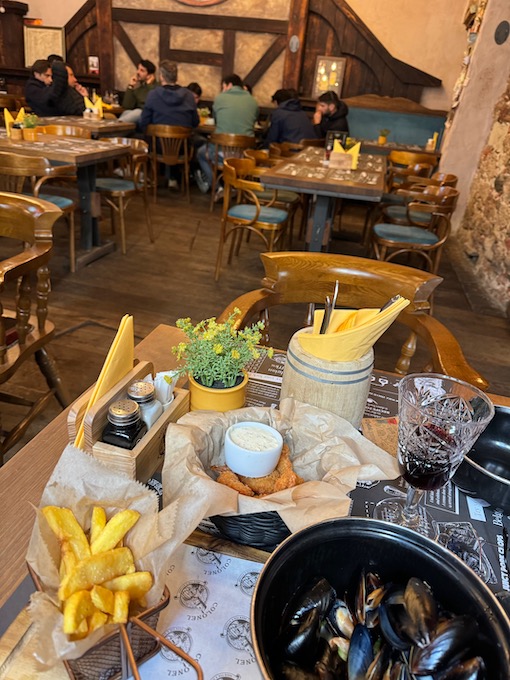
Excellent pubs and restaurants cater for locals and visitors. There are four places I suggest: a brewpub & kitchen, Colonel, where you can also enjoy Belgian beers, fries and mussels; a more authentic Belgian pub called Gastro Pub Duvel, with a lovely terrace, located on the ground floor of the Cat House. And there is the cosy bakery, Rigensis, from 1870, where you can taste delicious traditional pastry. That was my “headquarters” in Riga, where I drafted this post. Ultimately though, being a wine lover, my favourite place is Vina Studija, maybe the oldest wine pub in Riga.

Finally, and perhaps the most essential information in this article: it was with great surprise that I discovered a direct flight connects Sicily to Riga. We can bring the Latvians more sun and transfer some of their “quietude” to here in Sicily. We started with geometry and have finished with physics, confirming that opposites often attract. 

From Riga, you can now fly to Trapani Marsala Airport with Ryanair; the days depend on the time of the year. If you were to come to Sicily (besides visiting Riga), you could book this charming Targa Florio Apartment, owned by me, or through our Magazine, Times of Sicily, you could plan a five-star experience of places to visit, staying in one of the island’s magnificent Resorts.